
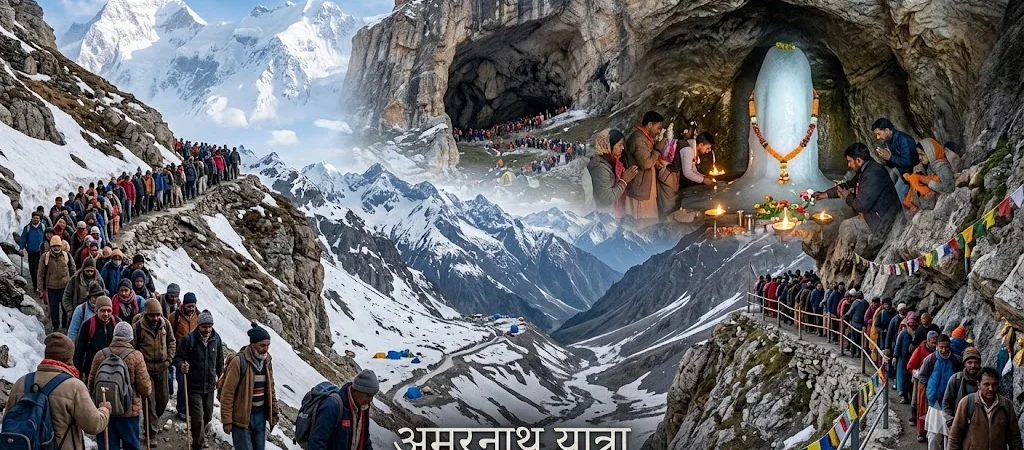
Amarnath Yatra 2026 officially concluded
The 57-day Shri Amarnath Ji Yatra 2026 concluded on August 28 — Raksha Bandhan and Shravan Purnima. The Chhari Mubarak (Lord Shiva’s Holy Mace) arrived at the holy cave shrine led by Mahant Deependra Giri. L-G Manoj Sinha performed the Samapan Puja marking the formal end.
4.8 lakh+ pilgrims completed darshan
Over 4.8 lakh devotees visited the holy cave shrine during the 2026 season — a significant increase compared to previous years. The pilgrimage ran through both Pahalgam and Baltal routes from July 3 to August 28.
Chhari Mubarak reached the cave today
The sacred mace completed its traditional Pahalgam route journey — staying at Pahalgam (Aug 22-23), Chandanwari (Aug 24), Sheshnag (Aug 25), Panchatarni (Aug 26-27), before reaching the holy cave on August 28. Visarjan (ritual immersion) in Lidder River at Pahalgam on August 30.
Two suspensions during the 2026 season
The Yatra was suspended twice — first from July 19-25 (6 days) due to heavy rainfall and highway landslides, and again from August 9 onward for BRO track repairs after rainfall damage on both routes. Both Chhari Mubarak and regular pilgrimage routes were affected.
Helicopter service was banned — full season
No Flying Zone was declared under Govt Order No. 321-HOME for the entire 2026 Yatra. No helicopter operations on any sector this year. All 4.8 lakh pilgrims completed darshan on foot, by pony, or by palki.
Amarnath Yatra 2027 — start planning now
The 2027 season dates will be announced by SASB in early 2027. Registration typically opens in April. If you missed the 2026 Yatra, now is the right time to plan ahead — helicopter availability and registration details often change year to year.
Plan your 2027 Yatra with Quest Kashmir
We are a Srinagar-based, government-registered travel company (JKTA00001332) with 20+ years of experience organising the Amarnath Yatra. WhatsApp us at +91 9797000322 to be notified when 2027 dates and registration open.
Last updated: August 28, 2026 — Season officially concluded
Voices of Our Last Few Yatris
Real experiences from pilgrims who recently completed their journey with Quest Tour & Travels. Their feedback validates our commitment to seamless logistics, absolute safety, and genuine Kashmiri hospitality.
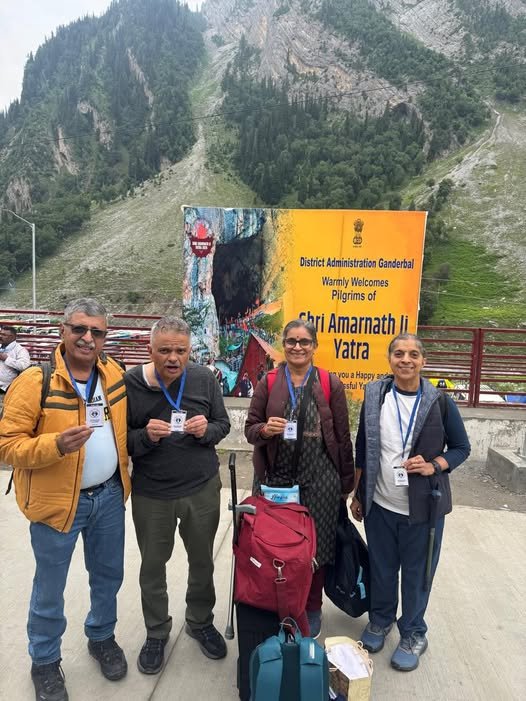
The Shri Amarnathji Yatra 2026 runs from 3rd July to 28th August 2026 (57 days). Registration opened on 15th April 2026 via jksasb.nic.in or designated bank branches, requiring a Compulsory Health Certificate dated on/after 8th April 2026, Aadhaar, and a ₹150 fee. Pilgrims choose between the shorter, steeper Baltal route (14 km) or the longer, gentler Pahalgam route (36–48 km), with helicopter shuttles available on both.
If you've spent any time googling "Amarnath Yatra package 2026," you've probably noticed the same problem we see every year. Ten different websites show ten different dates. Not one of them tells you what you actually need to know before you book.
We're a travel team based right here in Srinagar. We put together this guide the way we'd explain it to a friend sitting across from us. What the Yatra actually involves. Which route suits your body and your time. What it really costs, and the things nobody mentions until you're already on the trail. No recycled brochure copy, no inflated promises — just what we've learned from organising this Yatra year after year.
Amarnath Yatra 2026 at a Glance
The Shri Amarnathji Yatra 2026 runs from 3rd July to 28th August 2026, a 57-day window. The Shri Amarnathji Shrine Board (SASB) confirmed these dates at a board meeting the Lt. Governor of J&K chaired. Registration opened on 15th April 2026 through the SASB website and over 550 designated bank branches, and it stays open until seven days before your chosen travel date. Pilgrims need a Compulsory Health Certificate (CHC) dated on or after 8th April 2026. The route runs via either Pahalgam or Baltal, and helicopter shuttles cover both. The registration fee is around ₹150 per pilgrim for Indian nationals.
Our Amarnath Yatra Packages 2026
Choose the option that fits your route, time, and comfort level. All packages can be customised — message us on WhatsApp and we'll confirm the latest pricing and availability for your dates.
Pony, palki (palanquin), and porter charges are separate and range from ₹1,000 to ₹5,000+ depending on the service you choose, paid directly on the trail.
Prices can fluctuate based on hotel category, group size, and helicopter availability. For an accurate, up-to-date quote, contact us on WhatsApp or get in touch here.
Why People Get Stuck Planning This Yatra
Most pilgrims aren't stuck on the spiritual part — they already know why they're going. They're stuck on three practical things:
- They don't know if they're fit enough for the trek.
- They can't tell which route or package actually suits their family.
- They're worried about registration deadlines slipping past them.
So instead of writing another generic "everything about Amarnath Yatra" article, we're answering these three problems directly, in the order pilgrims usually ask them.
Amarnath Yatra 2026 Registration: How It Actually Works
Registration isn't optional. Your tour operator can't simply handle this for you behind the scenes — every individual needs a Yatra Permit issued in their own name.
Here's the real, step-by-step process:
- Get your Compulsory Health Certificate (CHC) from an SASB-authorised doctor. It must carry a date on or after 8th April 2026 — counter staff reject anything older on the spot.
- Carry your Aadhaar card along with the CHC. Both online and offline registration need it for identity verification.
- Register online at the official SASB portal (jksasb.nic.in) or through the "Shri Amarnathji Yatra" mobile app. Or register offline at any of the 550+ designated bank branches of SBI, PNB, ICICI, J&K Bank, Yes Bank, and Axis Bank across India.
- Pay the permit fee — roughly ₹150 for Indian pilgrims and higher for NRIs and foreign nationals, who go through a separate application link and need a valid passport.
- Collect your RFID card once your permit is confirmed. You cannot cross the access control gates at Domail (Baltal) or Chandanwari (Pahalgam) without it.
Travelling with family or in a group of five or more? Group registration is also open, and SASB processes applications first-come, first-served, based on slot availability for your chosen date and route.
One honest tip: don't wait until June to register. Bank counters get crowded fast once peak Shravan dates open up. Popular helicopter slots disappear within days.
Pahalgam or Baltal — Which Route Should You Actually Pick?
This is the question we get asked most. The honest answer: it depends on your body, not your budget.
Baltal route runs about 14 km one way. Most pilgrims finish it in a single hard day or split it across two. It's shorter, which sounds appealing, but the climb stays steep almost throughout. The thin air at that altitude tires people out faster than they expect. It suits fit, younger pilgrims who are comfortable with a tough, fast push.
Pahalgam route covers roughly 36–48 km across 3 to 5 days, passing through Chandanwari, Sheshnag, and Panchtarni before the final climb. It's longer, but the gradient is gentler. More medical camps and rest points line the way, and your body gets time to acclimatise gradually. This route is generally the better choice for families, first-timers, and anyone who isn't training for a fitness challenge.
We see this pattern often among experienced pilgrims: go up via Pahalgam, where the climb is forgiving, and come down via Baltal, since descending a steep trail is far easier than climbing it. It's a smart way to experience both routes without overexerting yourself on the way up.
Want to skip the decision entirely? Let a local team handle the logistics, hotel coordination, and transport between Srinagar, Pahalgam, and Baltal. Take a look at our tour packages — we build the itinerary around your fitness level and travel dates, not the other way around.
Amarnath Yatra by Helicopter: What It Actually Involves
Short on time? Travelling with older parents? Simply don't want to attempt the full trek? The helicopter option cuts the physical demand dramatically.
Two sectors currently operate:
- Baltal (Neelgrath) to Panchtarni — lands you about 6 km from the cave, which you cover on foot or by pony.
- Pahalgam to Panchtarni — a longer flight covering more of the traditional route by air.
Based on early 2026 figures, the Baltal sector fare was around ₹3,250 one-way and ₹6,500 for a same-day return. SASB revises heli fares each season, so always confirm current rates on the official portal or with your operator before booking. A helicopter ticket also doubles as your Yatra Permit, though you'll still need to carry a valid CHC.
Slots on the Baltal sector sell out fastest, sometimes within hours of booking opening. If a helicopter ride is part of your plan, book that first.
What Does Amarnath Yatra Cost in 2026, Really?
We won't quote you a single fixed number here. Anyone who does is either guessing or trying to undersell you on something that gets added back later. Instead, here's an honest breakdown of where your money actually goes:
- Registration/permit fee: ~₹150 per pilgrim (Indian nationals)
- CHC and travel to an authorised doctor: usually a nominal local fee
- Transport to Kashmir: flight, train, or road, depending on where you're starting from
- Local transport between Srinagar, Pahalgam/Baltal, and back — this varies hugely depending on vehicle type and group size
- Helicopter tickets, if you're using them, per sector
- Accommodation and meals at base camps or in Srinagar before and after the trek
- Pony or palanquin hire, if you need assistance on the trail (entirely optional and paid on the spot)
A short, no-frills Yatra by helicopter typically costs less overall than a longer trekking itinerary with multiple hotel nights, simply because you're saving on days. The right way to estimate your real cost: plan your exact itinerary first, then price each piece, not the other way around. Want that done properly? Our team can build a transparent, itemised quote based on your dates and route. Get in touch with us here.
Fitness, Oxygen, and the Honest Risk Conversation
We'd rather tell you this plainly than have you find out on the trail.
The Amarnath cave sits at roughly 3,888 metres. Oxygen levels run noticeably lower up there than what your body knows at sea level. Altitude sickness — headaches, breathlessness, nausea — is the most common reason pilgrims need medical attention along the route. It isn't dangerous for everyone, but it isn't something to ignore either.
What Actually Helps
- Start walking 4–6 km daily, on an incline if possible, at least a month before the Yatra.
- Practice basic breathing exercises like anulom-vilom to improve oxygen efficiency.
- Drink water steadily through the day rather than in large amounts at once.
- Spend a day acclimatising in Srinagar or at the base camp before you start trekking.
- Feel breathless or dizzy? Descend immediately rather than push through. Medical camps sit roughly every couple of kilometres along both routes for exactly this reason.
Who Should Think Twice
SASB has expanded infrastructure significantly in recent years: wider tracks, more medical camps with oxygen support, and 100-bed hospitals at Baltal and Chandanwari. The Yatra is demanding, but it's far better supported today than it was a decade ago. Doctors advise pilgrims with heart conditions, high blood pressure, respiratory issues, or advanced pregnancy against attempting it. The CHC screening exists specifically to catch this before you set off, not after.
Best Time and Duration: Planning Around the Crowd
Early July, right after the Yatra opens, tends to be a little calmer before the bulk of pilgrims arrive. Mid-to-late August, especially around Shravan Purnima and Raksha Bandhan, is when the cave sees its heaviest footfall. It's spiritually significant, but expect queues.
As for duration, it depends entirely on your route. A helicopter-assisted trip can realistically wrap up in 2–3 days from Srinagar. The full Pahalgam trek, done properly without rushing, takes 5–6 days including travel to and from Srinagar. Don't compress this into less time than your body needs. That's exactly how exhaustion-related issues happen.Getting Around Kashmir Before and After the Yatra
Most pilgrims fly into Srinagar, then need reliable transport to base camp, plus often a few days in the valley itself for sightseeing or simply recovering before the flight home. We run our own fleet — Innova Crystas, Tempo Travellers, and sedans — for exactly this kind of point-to-point and outstation travel. Need transport sorted separately from your package? Our car rental service covers everything from airport pickup to the full Srinagar–Pahalgam–Baltal loop.
Dates and Registration
What is the cost of Amarnath Yatra in 2026? There's no single fixed cost. It depends on your route, whether you use a helicopter, and your accommodation choices. Budget for the ₹150 registration fee, CHC charges, transport to and within Kashmir, optional helicopter tickets (roughly ₹3,250–₹6,500 per sector based on early 2026 rates), and stays. A detailed, itinerary-based quote will always beat a generic figure.
How can I register for Amarnath Darshan in 2026? Register online at jksasb.nic.in or through the SASB mobile app, or visit a designated bank branch in person. You'll need a Compulsory Health Certificate dated on or after 8th April 2026, your Aadhaar card, a passport-size photo, and the registration fee.
Amarnath Yatra opening date 2026 The Yatra opens on 3rd July 2026 and runs through 28th August 2026, a total window of 57 days. The Shri Amarnathji Shrine Board confirmed this schedule.
Amarnath Yatra 2026 registration online Online registration opened on 15th April 2026 through the official SASB portal. It stays open on a rolling basis until seven days before each travel date, so earlier dates close for registration sooner.
Helicopter and Travel
Amarnath Yatra 2026 by helicopter Helicopter services run on two sectors — Baltal (Neelgrath) to Panchtarni, and Pahalgam to Panchtarni — cutting most of the walking distance. It's the preferred option for older pilgrims, families with young children, or anyone working with limited time.
Amarnath Yatra 2026 helicopter booking You can book helicopter tickets through the official SASB heli-booking link or through an authorised travel operator. Baltal sector seats tend to sell out fastest, so book this as early as possible once your registration is confirmed.
Amarnath Yatra package from Delhi by air The usual route: fly from Delhi to Srinagar, then take road transport to Pahalgam or Baltal, followed by either a trek or helicopter ride to the cave. Most operators, including us, can build this as a single coordinated itinerary covering flights, local transfers, and the Yatra itself.
Route, Difficulty, and Safety
Which route is best for Amarnath Yatra 2026? Pahalgam suits families and first-timers, thanks to its gentler gradient and better-supported trail. Baltal suits fit, time-constrained pilgrims who want the shortest possible trek. Many experienced pilgrims go up via Pahalgam and return via Baltal.
Which month is best for Amarnath Yatra? Early July, right after the Yatra opens, generally sees lighter crowds. Mid-to-late August, around Shravan Purnima and Raksha Bandhan, is the most spiritually significant period but also the busiest.
How many days are sufficient for Amarnath Yatra? With a helicopter combined with a short road trip, 2–3 days from Srinagar is usually enough. The full Pahalgam trekking route needs about 5–6 days including travel time.
Is oxygen less in Amarnath? Yes. The cave sits at around 3,888 metres, where oxygen levels run noticeably lower than at sea level. This is the main reason behind the CHC requirement and the medical camps placed along the route.
How risky is Amarnath Yatra? It's a physically demanding high-altitude pilgrimage, and altitude sickness is the most common issue pilgrims face. Recent years have brought real safety improvements: wider trails, more medical camps, RFID tracking, and extra hospital beds at key points. The journey is considerably safer today than it used to be, provided pilgrims follow the fitness and health guidelines.
How many stairs are in Amarnath? Pilgrims who've completed the trek describe a final stretch of roughly 480 stone steps carved into the mountainside, right after the main trekking distance.
Which yatra is more difficult, Kedarnath or Amarnath? Both are demanding, but for different reasons. Kedarnath's trek covers more total distance. Amarnath's challenge comes more from its higher altitude and steeper, rockier terrain, particularly on the Baltal route. Most pilgrims who've done both call Amarnath the tougher one on the body, mainly because of the thinner air.
How long is Amarnath Walk? Via Baltal, it's about 14 km one way. Via Pahalgam, it's roughly 36–48 km one way, covered over several days.
Who cannot go to Amarnath Yatra? Pilgrims younger than 13 or older than 70 cannot register. Women more than six weeks pregnant also cannot register. Beyond age, anyone with serious heart conditions, uncontrolled high blood pressure, or major respiratory issues should consult a doctor before registering. The CHC screening exists specifically to flag these risks.
Planning Your Amarnath Yatra With Us? (Amarnath yatra package 2026 )
We've organised travel across Jammu, Kashmir, and Ladakh for over 20 years. Amarnath Yatra season is when that local knowledge matters most: knowing which route suits which traveller, which dates to avoid, and how to keep a group moving safely without losing the meaning of why they came.
Want to hand off the planning and just show up ready for darshan? Browse our Amarnath Yatra and Kashmir tour packages, check our car rental options for getting around the valley, or simply reach out to our team directly and tell us your dates. We'll take it from there.
Common Problems Pilgrims Run Into.
These are the real problems faced by people, when planning the Amarnath Yatra. Short, honest answers — no fluff.
No — and in 2026, this is being enforced strictly. Only registered pilgrims are allowed to proceed towards the cave. Unregistered pilgrims are being stopped at designated checkpoints before they even reach Kashmir. The Supreme Court has fixed a daily cap on how many pilgrims can be on the route at any time, and authorities are not making exceptions. Tatkal (on-the-spot) slots exist but are extremely limited — don't count on them. Register in advance at the SASB portal or a designated bank branch before you travel.
As of July 2026, thousands of unregistered pilgrims have arrived in J&K only to be stopped at checkpoints. The J&K administration has asked them to wait — not proceed — until fresh registration quotas open. All registration slots were booked till July 9th due to an unprecedented surge of pilgrims in the first few days. The administration's message is clear: complete advance registration before you travel, and travel only on your allotted date. If you've already arrived without registration, wait patiently at your current location and watch the SASB portal for new slot availability.
You get stopped. Security checkpoints have been set up on the routes to Baltal and Pahalgam, and only pilgrims carrying a valid RFID card (issued with your registration) are allowed through. If you've travelled from another state without registering, you'll be stuck waiting in Jammu or at a checkpoint — at your own cost — until a slot opens up for you. Tatkal registrations are extremely limited and cannot accommodate large numbers. The honest answer: don't try it. The process takes 15 minutes online and ₹150. It's not worth the risk.
You can arrive in Jammu or Srinagar early, but you cannot start the Yatra trek before the date printed on your permit. The administration is strict about this — early arrival does not mean early movement on the route. If your permit says July 15th, you wait until July 15th. Arriving two days early just means two extra nights of hotel expenses in Jammu or Srinagar with nothing to do. Plan your travel so you arrive a day before your registered date at most — enough time to reach base camp comfortably without burning unnecessary money waiting.
This catches a lot of pilgrims off guard. Prepaid SIM cards from outside J&K do not work in Jammu & Kashmir. This is a longstanding regulatory restriction in the region — your Airtel, Jio, or Vi prepaid SIM from Delhi, Mumbai, or anywhere else will show "No service" once you're in J&K. BSNL has the best coverage on both the Baltal and Pahalgam routes, especially at higher altitudes where other networks drop out completely. Your best options: get a BSNL prepaid SIM in Jammu or Srinagar before heading to base camp, or use a postpaid connection from any network (postpaid works across J&K). Telecom counters at base camps also issue special Yatra SIMs to pilgrims — ask for one when you arrive.
Yes — BSNL has the widest coverage on both the Baltal and Pahalgam routes and works better than any private network at high altitude. Signal isn't perfect everywhere (some stretches near Sheshnag and Panchtarni are patchy for everyone), but BSNL gives you the best chance of staying connected throughout the trek. Pick up a BSNL prepaid SIM in Jammu or Srinagar city before you head to base camp — it's inexpensive and widely available there.
Build in at least 2 extra days beyond your planned itinerary. Here's why: the Jammu-Srinagar national highway closes several times every season due to landslides, heavy rain, or road damage — usually at the Ramban section. When it closes, everyone waits. Past seasons have seen the Yatra suspended for 3 to 4 consecutive days, leaving thousands of pilgrims stranded in Jammu. If you've booked a return flight on the day you expect to finish, a single weather disruption can blow your entire plan. Book flexible return tickets where possible, and don't schedule important work or family commitments immediately after your expected return date.
The Pehchan App is a QR-code based security and identity verification app launched by J&K Police for the 2026 Yatra season. It links your registration details to a scannable QR code that security personnel can check at checkpoints along the route. Think of it as a digital version of your RFID card — it speeds up verification, reduces queues at access control points, and gives authorities a way to track pilgrim movement for safety. Download it from the App Store or Play Store before you travel, register your permit details inside the app, and carry it alongside your physical RFID card. Not mandatory yet, but having it avoids delays at security gates.
This is the one that surprises pilgrims most — and it can cost you an entire day if you miss it. Traffic on the Jammu-Srinagar highway is one-directional during Yatra season, and the Navyug Tunnel has strict cut-off timings. Vehicles travelling from Jammu towards Kashmir cannot cross the Navyug Tunnel after 3 pm. Vehicles going from Kashmir towards Jammu cannot cross before 11:30 am. Additional cut-off times apply at other points: vehicles going from Mir Bazar towards Srinagar or Anantnag must cross by 4 pm, and all vehicles must cross the Navyug Tunnel by 5 pm. Miss these windows and you wait until the next day's convoy. Plan your road travel to reach the tunnel well before the cut-off, not just at the cut-off.
Weather suspensions happen almost every season — usually due to heavy rain, landslides, or snow on the higher stretches of the route. When SASB suspends the Yatra, no pilgrim is allowed to proceed on the trail until the route is declared safe again. Here's what to do if it happens to you: stay at your current base camp or the nearest safe shelter — do not try to continue on your own. SASB and the administration provide updates through official channels and local PA systems at base camps. Suspensions usually last between a few hours and a few days. Once the route reopens, movement resumes in an orderly convoy system. This is exactly why building 2 buffer days into your itinerary matters — and why booking with a local operator who monitors the route conditions in real time is worth it. Our team tracks route advisories daily during the season and keeps all our groups informed as conditions change.